
Hidden Arctic World Discovered Deep Below the Greenland Sea
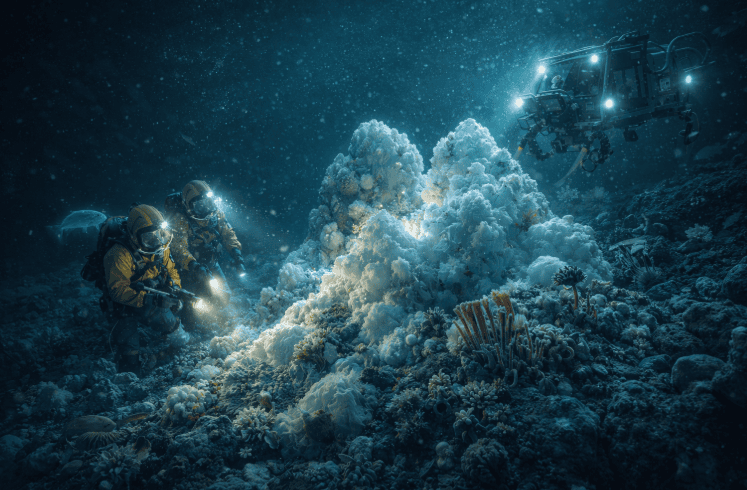
(Disclaimer: AI-generated visuals created to represent real news events in a symbolic and editorial context.)
Scientists exploring the Arctic’s deep ocean have uncovered a remarkable ecosystem thriving 3.6 kilometres beneath the Greenland Sea—far below the reach of sunlight and in conditions once thought inhospitable to complex life. Along the Molloy Ridge, researchers found dynamic methane hydrate mounds forming intricate geological structures that support strange and resilient life forms.
These “gas hydrate mounds” act like frozen reefs, hosting an array of organisms adapted to the cold, high-pressure, and dark environment. The discovery pushes the boundaries of known marine biological diversity and underscores how life can persist in extreme habitats that were once considered barren.
From a geological perspective, the presence of such features provides new insights into subsea methane dynamics and how methane hydrates can influence global climate processes. Methane is a potent greenhouse gas, and understanding how it cycles in deep-sea environments has implications for climate models and future predictions.
For young explorers and Earth scientists, this hidden world is a potent reminder that some of the planet’s most astonishing ecosystems remain undiscovered. Its existence invites further research into extreme life, climate interconnections, and the complex tapestry of Earth’s biosphere.